Solar Panel Inspection: How Drone Inspection Works on Solar Farms
Operations & Maintenanceeyerod · · 14 min read
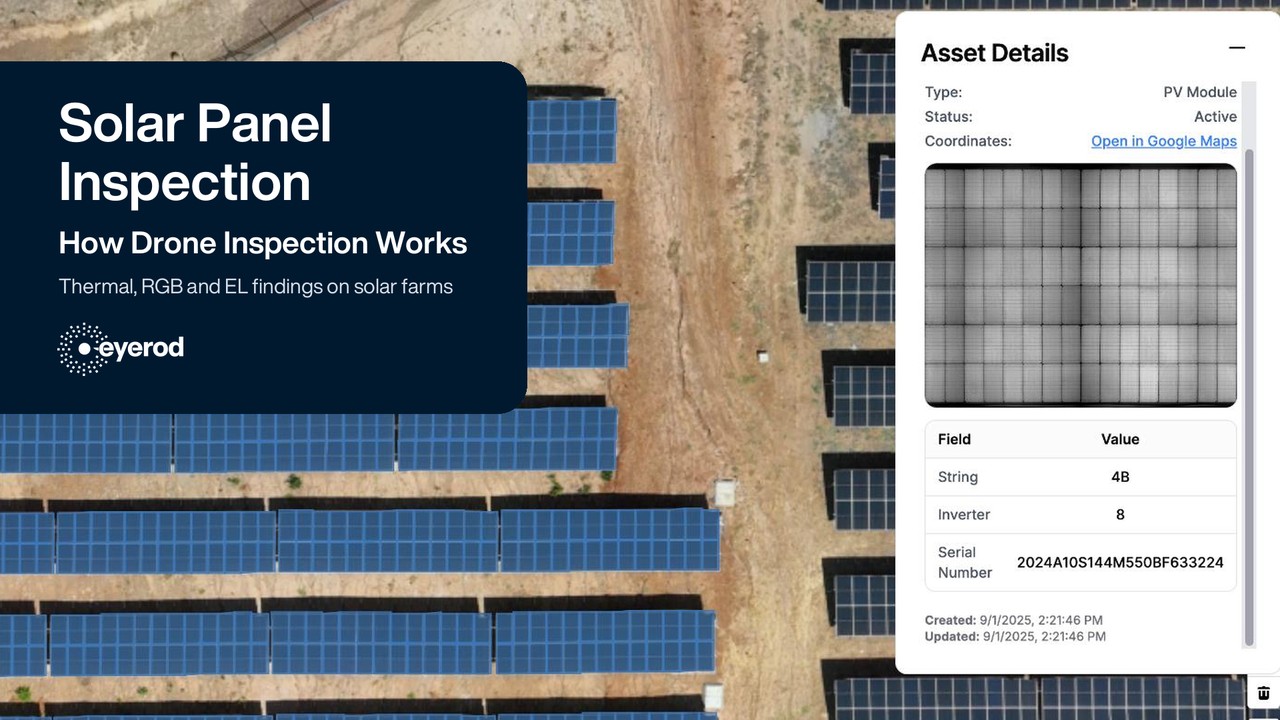
On utility-scale solar farms, solar panel inspection is an essential part of quality control, preventive maintenance and long-term asset management. With tens or even hundreds of thousands of photovoltaic (PV) modules installed across a single site, identifying, locating and documenting individual panel defects requires a systematic inspection approach.
Drone solar panel inspection enables solar investors, EPC contractors and operations and maintenance (O&M) teams to examine large-scale photovoltaic installations using aerial thermal and RGB imagery. Combined with electroluminescence (EL) analysis, electrical measurements and digital asset records, these inspections provide a more comprehensive understanding of a solar power plant's physical condition.
However, collecting aerial imagery is only one part of the inspection process. The real value lies in how the collected data is analyzed, associated with individual assets and translated into maintenance and investment decisions.
What Is Solar Panel Inspection?
Solar panel inspection is the systematic examination of photovoltaic modules to identify physical damage, thermal anomalies, electrical irregularities and other conditions that may affect module reliability, safety or energy production.
On utility-scale solar farms, inspections can be conducted throughout the entire project lifecycle, from module procurement and installation to commissioning and long-term operation.
A broader solar system inspection may also include mounting structures, DC cabling, connectors, combiner boxes, inverters, tracking systems and other balance-of-system (BOS) components.
Depending on the inspection method, solar panel inspection can help teams:
- Locate hotspots and abnormal temperature distributions.
- Identify patterns associated with electrical faults.
- Detect microcracks and inactive cell areas.
- Document physical damage, shading and soiling.
- Support EPC acceptance and commissioning procedures.
- Prioritize preventive and corrective maintenance.
- Collect evidence for manufacturer warranty claims.
- Establish a historical record of asset condition.
Each inspection method provides a different type of evidence. Selecting the appropriate method depends on the technical question being investigated.
Why Do Solar Farms Need Physical Inspections?
Solar power plants typically use monitoring systems to track energy production, inverter performance, string currents and environmental conditions.
Although these systems provide continuous operational data, their measurement resolution does not necessarily correspond to the physical resolution of the plant.
A reduction in string output, for example, may indicate an electrical or performance issue. However, operating data alone may not identify which individual module is affected or explain the underlying cause.
Drone solar inspection addresses this visibility gap by adding location-based physical evidence to operational data.
Thermal imagery reveals abnormal temperature distributions, RGB imagery provides visual context, and electroluminescence analysis makes certain cell-level defects visible.
These methods complement rather than replace conventional monitoring infrastructure.
Read more: Why Solar Monitoring Data Isn't Enough – What Physical Inspections Add.
What Are the Different Types of Solar Panel Inspection?
A comprehensive inspection strategy combines multiple methods according to the plant's lifecycle stage, operating conditions and technical requirements.
| Inspection method | Primary findings | Typical application |
|---|---|---|
| Visual inspection (RGB) | Visible damage, shading, soiling and installation irregularities | Construction and operation |
| Infrared thermal inspection | Hotspots and abnormal temperature patterns | Commissioning and operation |
| Electroluminescence (EL) inspection | Microcracks, inactive cell areas and interconnection defects | Procurement, acceptance and fault investigation |
| I-V curve testing | Electrical performance deviations | Commissioning and troubleshooting |
| Insulation resistance testing | Insulation integrity issues | Commissioning and electrical safety assessments |
Visual Inspection
Visual inspection examines the external condition of solar modules and associated equipment.
High-resolution RGB images can help identify broken glass, surface contamination, vegetation-related shading and certain visible installation issues.
Drone imagery allows maintenance teams to examine large areas efficiently. However, some defects require closer ground-level examination.
Thermal Inspection
Solar panel thermal inspection uses infrared cameras to examine temperature distribution across photovoltaic modules during operation.
Under suitable environmental and electrical conditions, abnormal heating patterns can indicate areas that require further technical investigation.
Thermal cameras can reveal patterns associated with hotspots, bypass diode issues, potential-induced degradation (PID) and open-circuit conditions.
The directly relevant technical reference for outdoor PV thermography is IEC TS 62446-3:2017. Which heat findings thermal inspection makes visible is covered in Which Heat Findings Does Thermal Inspection Make Visible at a Solar Plant?
Electroluminescence (EL) Inspection
Electroluminescence testing examines the near-infrared light emitted by photovoltaic cells under controlled electrical excitation.
Unlike thermal inspection, EL imaging can reveal certain internal cell defects even when they do not produce a detectable temperature anomaly.
These include microcracks, broken cells, electrically inactive regions and some interconnection defects.
IEC TS 60904-13:2018 provides a technical framework for capturing, processing and interpreting EL images of photovoltaic modules.
Read more: What Is an Electroluminescence (EL) Test?
Electrical Testing
Electrical measurements provide complementary information about the performance and electrical integrity of photovoltaic installations.
I-V curve measurements, string current measurements, open-circuit voltage testing and insulation resistance testing can support the investigation of anomalies identified through imagery.
A drone inspection does not replace these measurements or all of the electrical safety checks required during commissioning.
How Does Drone Solar Panel Inspection Work?
Drone solar panel inspection, also referred to as UAV solar panel inspection, uses unmanned aerial vehicles equipped with thermal and RGB cameras to collect imagery across a photovoltaic installation.
The process involves several stages, from data acquisition to maintenance planning.
1. Site Assessment and Flight Planning
Before the inspection, the site boundaries, module layout, terrain, obstacles and inspection objectives are evaluated.
Flight parameters are established according to the required image resolution, camera characteristics and site conditions.
These parameters include:
- Flight altitude and speed.
- Image overlap.
- Camera viewing angle.
- Ground sampling distance (GSD).
- Flight coverage and route.
- Airspace and operational restrictions.
A successful flight is not simply one that covers the entire solar farm. It must also produce imagery with sufficient detail for the intended analysis. How GSD and overlap are chosen is explained in What Is an Orthomosaic? Drone Orthomosaic Maps Explained.
2. Environmental and Operating Conditions
Reliable thermal imagery requires suitable measurement conditions.
Solar irradiance, wind, cloud coverage, module temperature and electrical operating conditions influence the thermal signatures recorded during a flight.
For outdoor PV module thermography, IEC TS 62446-3 specifies a minimum plane-of-array irradiance of 600 W/m², alongside other environmental and measurement requirements.
The plant's electrical operating state must also be considered. Modules operating under different electrical conditions may exhibit different temperature distributions, regardless of their physical condition.
These parameters should be documented alongside the inspection data.
Read more: How Drone Thermal Inspection Works – and When Results Can Be Trusted.
3. Thermal and RGB Image Collection
During the solar panel drone inspection, the UAV collects thermal and visual imagery across the project area.
Radiometric thermal images retain temperature-related measurement data, while RGB images help contextualize visible conditions such as shading, vegetation and surface contamination.
Evaluating both data sources together reduces the risk of interpreting a temperature difference without considering its physical surroundings.
4. Image Processing and Asset Mapping
The collected imagery is processed and associated with its geographical location.
Depending on the inspection scope, this can involve orthomosaic generation, module identification and alignment with the plant's electrical and physical layout.
Geospatial mapping allows detected anomalies to be associated with specific modules, rows, strings or areas.
This is particularly important on utility-scale installations, where manually locating a single affected module among hundreds of thousands of panels can be time-consuming.
5. AI-Assisted Thermal Anomaly Detection
AI-assisted image analysis can help identify, classify and locate recurring thermal patterns across large volumes of inspection data.
Instead of reviewing every aerial image manually, inspection teams can focus on flagged areas and findings that require further evaluation.
The accuracy of this process depends on image quality, environmental conditions, module technology and the suitability of the analysis model.
Automated classification supports technical evaluation but does not independently establish the root cause of every anomaly.
6. Verification, Reporting and Maintenance
Inspection findings are reviewed and documented with their geographical location, thermal and RGB evidence, observed pattern and recommended next steps.
Where necessary, maintenance teams can conduct additional visual inspections, EL tests or electrical measurements to confirm the underlying issue.
Following cleaning, repair or module replacement, the affected area can be inspected again to evaluate the outcome.
What Can a Solar Farm Drone Inspection Detect?
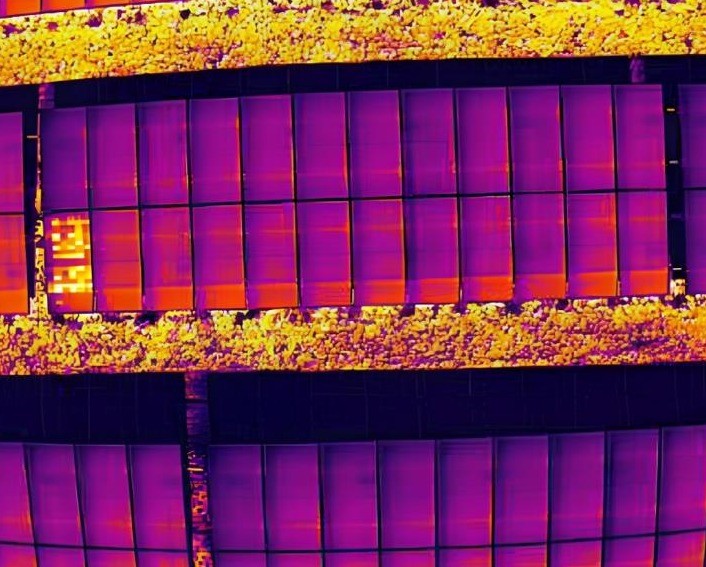
A solar farm drone inspection can reveal several types of thermal and visual findings across an operating photovoltaic installation.
| Inspection finding | Typical appearance | Possible follow-up |
|---|---|---|
| Hotspot | Localized elevated temperature | Visual inspection, EL or electrical testing |
| Suspected bypass diode issue | Temperature differences across a module substring | Diode and electrical checks |
| Suspected PID | Abnormal heating patterns across cells or modules | Electrical measurements and EL analysis |
| Open-circuit module or string | Temperature differences relative to nearby operating assets | Circuit and connection checks |
| Soiling | Localized or distributed surface contamination | Visual confirmation and cleaning |
| Shading | Visible obstruction with associated thermal patterns | Site inspection and shading assessment |
| Visible physical damage | Observable surface or structural irregularities | Ground-level examination |
A thermal anomaly should not automatically be classified as a confirmed equipment failure.
For example, a hotspot may be associated with cell damage, shading, contamination or an electrical irregularity. Additional evidence may be required to distinguish between these possible causes.
Similarly, a microcrack that does not produce a detectable temperature difference may remain invisible during a conventional thermal survey.
For a detailed examination of these findings, read PV Panel Faults: Detecting Hotspots, PID, String and Diode Issues.
Solar Inspection After Installation: From EPC Handover to Commissioning
Solar inspection after installation is an important quality control stage before a photovoltaic power plant enters commercial operation.
Between manufacturing and final installation, modules are exposed to transportation, unloading, storage, handling and installation-related mechanical stresses.
Some resulting defects may not be immediately visible.
A structured inspection process can help EPC contractors and investors document the physical and electrical condition of the installation before final acceptance.
Depending on contractual requirements and the project's inspection and test plan (ITP), this process may include:
- Visual examination of installed modules.
- EL image analysis and comparison with earlier records.
- Electrical commissioning tests.
- Thermal inspection under suitable operating conditions.
- Verification of module locations and serial numbers.
- Documentation of outstanding defects and corrective actions.
IEC 62446-1 provides a framework for commissioning tests, inspection and documentation of grid-connected PV systems.
The records generated during commissioning can also establish a baseline for future maintenance, warranty evaluations and asset condition assessments.
Read more: Punch Lists and ITPs: Managing Solar Quality Before Closeout.
Solar Panel Inspection Checklist
A structured solar panel inspection checklist helps ensure that data collection, technical evaluation and reporting requirements are addressed consistently.
| Stage | Inspection checklist |
|---|---|
| Preparation | Define site boundaries and inspection scope |
| Preparation | Review module layout and electrical documentation |
| Preparation | Evaluate equipment suitability and calibration |
| Data collection | Record irradiance, wind and environmental conditions |
| Data collection | Verify plant operating conditions |
| Data collection | Capture thermal and RGB imagery |
| Data collection | Verify image resolution and site coverage |
| Analysis | Identify and classify observed anomalies |
| Analysis | Associate findings with individual assets and locations |
| Analysis | Evaluate findings requiring additional tests |
| Reporting | Document inspection conditions and supporting imagery |
| Reporting | Establish maintenance priorities |
| Follow-up | Record cleaning, repair or replacement activities |
| Follow-up | Compare findings with subsequent inspections |
For utility-scale projects, maintaining this information in a centralized digital environment can improve traceability between inspection teams, asset managers and maintenance contractors.
This checklist is a general framework and should be adapted to applicable standards, contractual requirements and site-specific inspection procedures.
How Often Should Solar Farms Be Inspected?
There is no universal solar panel inspection frequency suitable for every photovoltaic installation.
Inspection intervals should reflect plant age, environmental exposure, previous findings, equipment reliability, maintenance contracts and project-specific risk assessments.
Inspections are particularly valuable at the following stages:
- During commissioning and EPC handover.
- As part of scheduled preventive maintenance.
- Before relevant warranty periods expire.
- Following hailstorms, flooding or severe weather events.
- After unexpected reductions in energy production.
- Before acquisitions and asset transfers.
- Following significant repair or module replacement activities.
Periodic inspections become more valuable when the results can be compared against earlier surveys.
A single thermal inspection provides information about asset condition at a specific point in time. A historical thermal record can help identify recurring anomalies, newly emerging findings and changes following maintenance activities.
Read more: How Periodic Thermal Records Support a Solar Maintenance Plan.
How Much Does Solar Panel Inspection Cost?
Solar panel inspection cost varies according to the size, location and technical requirements of the photovoltaic installation.
For utility-scale projects, inspection pricing may be calculated per megawatt, per module, per inspection campaign or according to a defined service scope.
The primary factors affecting inspection costs include:
| Cost factor | Impact on inspection scope |
|---|---|
| Installed capacity (MWp) | Determines the approximate scale of the inspection |
| Number of PV modules | Influences module-level analysis and EL inspection scope |
| Site layout and accessibility | Affects flight planning and field logistics |
| Inspection methodology | Determines whether thermal, RGB, EL or electrical testing is required |
| Image resolution | Influences data collection time and processing volume |
| Inspection frequency | Determines whether surveys are one-time or recurring |
| Reporting requirements | Affects the level of technical analysis and documentation |
| Digital twin integration | Determines the scope of asset mapping and historical data management |
When comparing inspection quotations, it is important to distinguish between aerial data collection, technical image analysis, electrical verification and digital asset management.
Two inspections covering the same installed capacity may deliver substantially different outputs depending on the service scope.
The cost of an inspection should therefore be evaluated alongside the usability of its deliverables and their contribution to long-term asset management.
What to Look for in Solar Panel Inspection Services
Selecting solar panel inspection services requires more than evaluating drone equipment or comparing flight prices.
A qualified solar panel inspection company should demonstrate an understanding of photovoltaic systems, thermography, data collection conditions and technical reporting requirements.
Solar investors and asset managers should evaluate the following:
- Experience with utility-scale photovoltaic installations.
- Inspection methodology and applicable IEC references.
- Thermal camera suitability and image resolution.
- Environmental and electrical measurement records.
- Module-level identification and geospatial mapping.
- Anomaly classification and technical review procedures.
- Access to original imagery and inspection records.
- Recommendations for further technical investigation.
- Compatibility with existing asset management workflows.
- Ability to compare historical and future inspection results.
The final deliverable should allow maintenance teams to understand what was observed, where it was observed and what action may be required.
From Solar Panel Inspection to Digital Asset Intelligence
Traditional solar inspections often conclude with a standalone report containing thermal images, anomaly classifications and recommended maintenance activities.
While these reports provide valuable technical information, isolated documents can make it difficult to compare asset condition over multiple years.
A digital twin provides a structured environment in which inspection results can be associated with individual physical assets throughout the lifecycle of a photovoltaic installation.
For example, a single PV module's record may include:
- Module serial number.
- Geographical location.
- Historical EL analysis.
- Thermal inspection findings.
- Inspection dates.
- Maintenance and replacement history.
- Quality control and acceptance records.
When subsequent inspections are associated with the same digital asset, teams can evaluate changes in condition without having to reconstruct the module's history from separate reports.
This approach transforms inspection data into a continuously developing asset record.
Read more: What Is a Solar Digital Twin? One Data Model from Construction to Operations.
Solar Panel Inspection with eyerod
eyerod is a Solar Intelligence Platform developed for utility-scale photovoltaic projects, connecting quality control, construction management and long-term operations within a single digital environment.
Asset Intelligence – Thermal Analysis & Digital Twin
eyerod Asset Intelligence processes thermal and RGB field imagery, identifies supported thermal anomaly patterns and associates findings with the relevant assets and geographical locations.
Through the digital twin, solar investors and O&M teams can review individual module records, compare thermal inspections over time and maintain a structured history of asset condition.
Quality Intelligence – EL Image Analysis
eyerod Quality Intelligence analyzes existing electroluminescence images using artificial intelligence, supporting the identification and classification of cell-level defects, including microcracks and structural irregularities.
Module-level findings can be evaluated against defined acceptance criteria, supporting procurement and quality control decisions before and during installation.
Construction Intelligence – Site Management
eyerod Construction Intelligence connects drone-based site imagery with construction progress, quality records and project management workflows.
By connecting these three solutions, eyerod enables project stakeholders to establish a continuous digital record from module procurement to long-term plant operation.
The objective is not simply to identify anomalies during a solar inspection, but to make inspection findings traceable, comparable and actionable throughout the asset's lifecycle.
Turn Solar Inspection Data Into Long-Term Asset Intelligence
Every solar panel inspection creates information about the condition of a photovoltaic installation. The long-term value of that information depends on how consistently it is recorded, connected to physical assets and used in future decisions.
With eyerod, thermal imagery, EL analysis and digital asset records become part of a connected solar project management platform.
Explore eyerod solutions to see how inspection data can be managed across the entire lifecycle of your solar power plant, or request a demo.
Frequently asked questions
What is a solar panel inspection?
A solar panel inspection evaluates the physical, thermal or electrical condition of photovoltaic modules to identify potential defects, performance irregularities and maintenance requirements.
Can drones inspect solar panels?
Yes. Drones equipped with thermal and RGB cameras can collect aerial imagery across utility-scale solar farms, enabling wide-area inspection and location-based anomaly detection.
Can drone solar panel inspection detect microcracks?
Conventional aerial thermal inspection may reveal temperature anomalies associated with some damaged cells. However, microcracks that do not produce detectable thermal contrast generally require electroluminescence imaging or other suitable investigation methods.
How long does a solar farm drone inspection take?
Inspection duration depends on installed capacity, site layout, flight conditions, image resolution and analysis requirements. Data collection and technical reporting should be considered separate stages.
Can solar panel inspection be conducted without shutting down the plant?
Conventional outdoor thermal inspections are generally conducted while the photovoltaic plant is operating under suitable conditions. Certain electrical tests and detailed investigations may require isolation of specific equipment.
Does thermal inspection measure solar panel power loss?
A thermal image identifies temperature patterns and anomalies. Quantifying electrical performance losses requires additional measurements or appropriate engineering analysis.
What is the difference between thermal inspection and EL inspection?
Thermal inspection examines temperature distribution during operation, while EL inspection examines light emitted by electrically excited photovoltaic cells. The two methods provide complementary information about module condition.
What Is an Orthomosaic? Drone Orthomosaic Maps Explained