How Periodic Thermal Records Support a Solar Maintenance Plan
Operations & Maintenanceeyerod · · 4 min read
A maintenance plan for a solar plant is more than a calendar. Plant age, equipment architecture, warranty terms, past faults, climate, insurance conditions and operational risk together decide which check happens when. Treating thermal inspection as a single practice that replaces the whole maintenance programme is therefore the wrong framing.
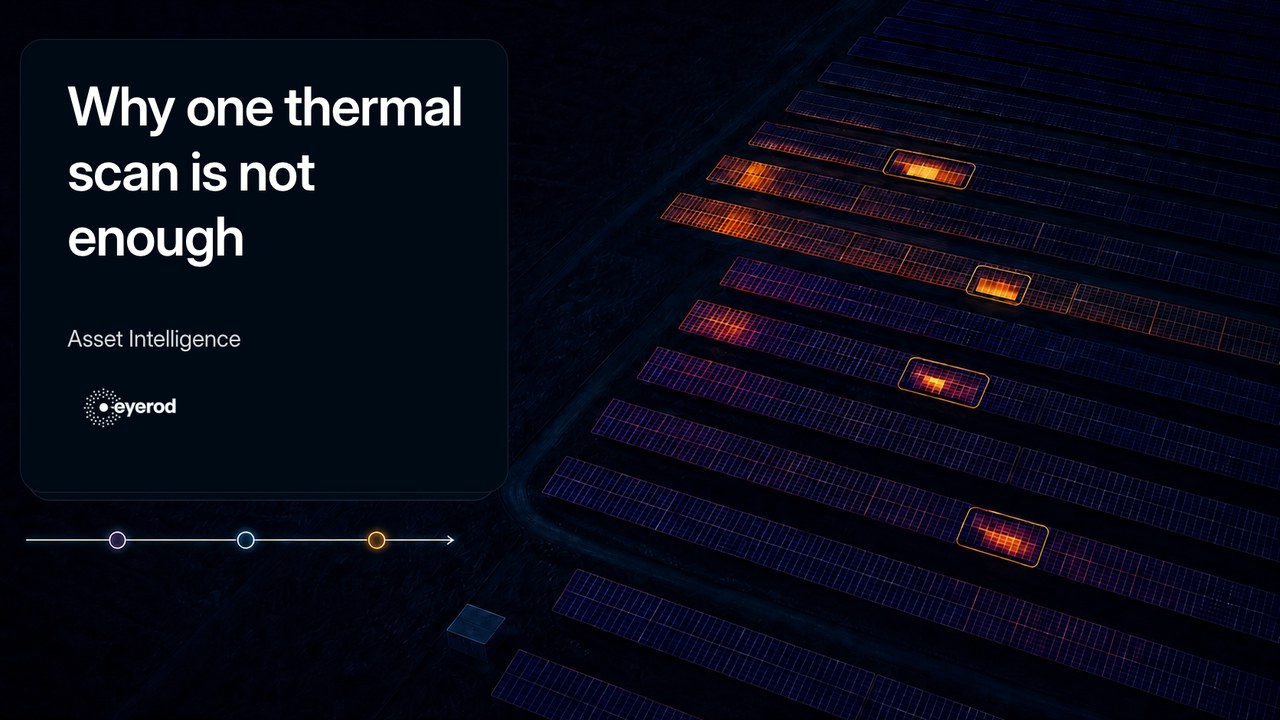
What a thermal record contributes is different: it makes temperature differences across a large site visible together with their location, and it creates a starting point for comparing the condition of the same assets over time.
Which maintenance questions need which data?
A thermal scan can show temperature patterns that may warrant a closer look at a particular module, connector or piece of equipment. What it does not measure on its own is insulation resistance, every issue inside an inverter, or the power loss of a module. Those questions call for a field check, an electrical measurement, operational data, or other suitable tests.
That distinction makes the maintenance decision clearer. A thermal finding helps answer "where should we look?"; confirming the root cause and choosing the intervention stays with the relevant technical team.
Why is a periodic record worth more than a one-off report?
A single scan records what was visible under that day’s operating and environmental conditions. When the same site is scanned again, the team can read new findings alongside the earlier records. That lets these questions be handled more systematically:
- Has a finding appeared on this module or equipment before?
- Does the pattern persist after the previous field action?
- Is the finding concentrated in a particular area?
- Has the inspection priority changed?
This comparison does not automatically produce a fault diagnosis or a forecast of future performance. It does, however, give a firmer working basis, one where decisions connect to a history instead of starting from scratch at every visit.
Data conditions have to be comparable
A year-on-year comparison only means something when the context of the data is recorded too. Irradiance, wind, cloud cover, the plant’s operating state, the flight plan, camera details and resolution can all change how a thermal image looks. A difference in how visible a finding is may come from the capture conditions rather than from a change in physical condition.
For that reason a thermal report should record not only the finding but also the conditions under which the imagery was captured. For the capture conditions themselves, see how drone thermal inspection works.
How does a digital twin support the maintenance decision?
Thermal analysis produces the finding; the digital twin ties that finding to an asset, a location and a date. When the module’s serial number, its position on site, its previous image and any open action record sit in the same context, the maintenance team can work far more precisely.
This matters most on large sites. Instead of "a temperature difference was seen in Block 4", the record can say "this check is recommended for this asset at this location". When the site visit, the work order and the closing note attach to the same record, technical continuity is preserved.
eyerod Asset Intelligence is built to match completed thermal analysis results to asset and location records inside Thermal Analysis and Digital Twin. The platform does not provide maintenance services, electrical testing or field intervention; it creates an orderly record of physical site condition that maintenance teams can work from.
What does eyerod do in the thermal workflow?
eyerod analyzes thermal and RGB imagery captured by drone to identify temperature patterns that warrant attention, and matches each finding to the location of the relevant module or equipment. Inside Thermal Analysis and Digital Twin, every finding becomes traceable together with its image, location, class and history.
That gives the maintenance team a more orderly starting point for the question "where on site should we look?". eyerod does not perform root-cause confirmation, electrical testing or field intervention; those steps belong to the relevant technical team. The platform’s role is to turn thermal data into a site record that is comparable and can be tied to an action.
Is there a universal thermal inspection frequency?
No. The right frequency for a given site should follow the plant’s risk profile alongside contractual and warranty requirements. Beyond the planned scans, events such as hail, storms, a fire incident, a marked change in performance or a recurring finding can create a need for an additional inspection.
The goal is not to run every check with a thermal camera. The goal is to know which data supports which decision, and to connect a finding to a traceable action flow.
Conclusion
A periodic thermal record is not the whole solar maintenance programme; collected under the right conditions, though, it adds located, comparable site context to the plan. The best results come from reading thermal findings together with operational data, field checks and the technical tests the case requires.
Frequently asked questions
How often should a solar plant be thermally inspected?
There is no single frequency that fits every site. The right interval follows the plant’s risk profile alongside contractual and warranty requirements. Hail, storms, a fire incident, a marked change in performance or a recurring finding can each create a need for an additional inspection.
Does a thermal scan measure a module’s power loss?
It does not. A thermal scan shows temperature patterns that may warrant closer inspection; power loss, insulation resistance and problems inside an inverter call for a field check, electrical measurement and other suitable tests.
Can thermal scans from two different years be compared directly?
Only if the capture conditions were recorded too. Irradiance, wind, cloud cover, the plant’s operating state, the flight plan, camera details and resolution all change how a thermal image looks; without them, a difference in visibility can be mistaken for a physical change.
Does an EL Image Measure a Panel's Annual Power Loss?