What Is a Solar Digital Twin? One Data Model from Construction to Operations
Operations & Maintenanceeyerod · · 7 min read
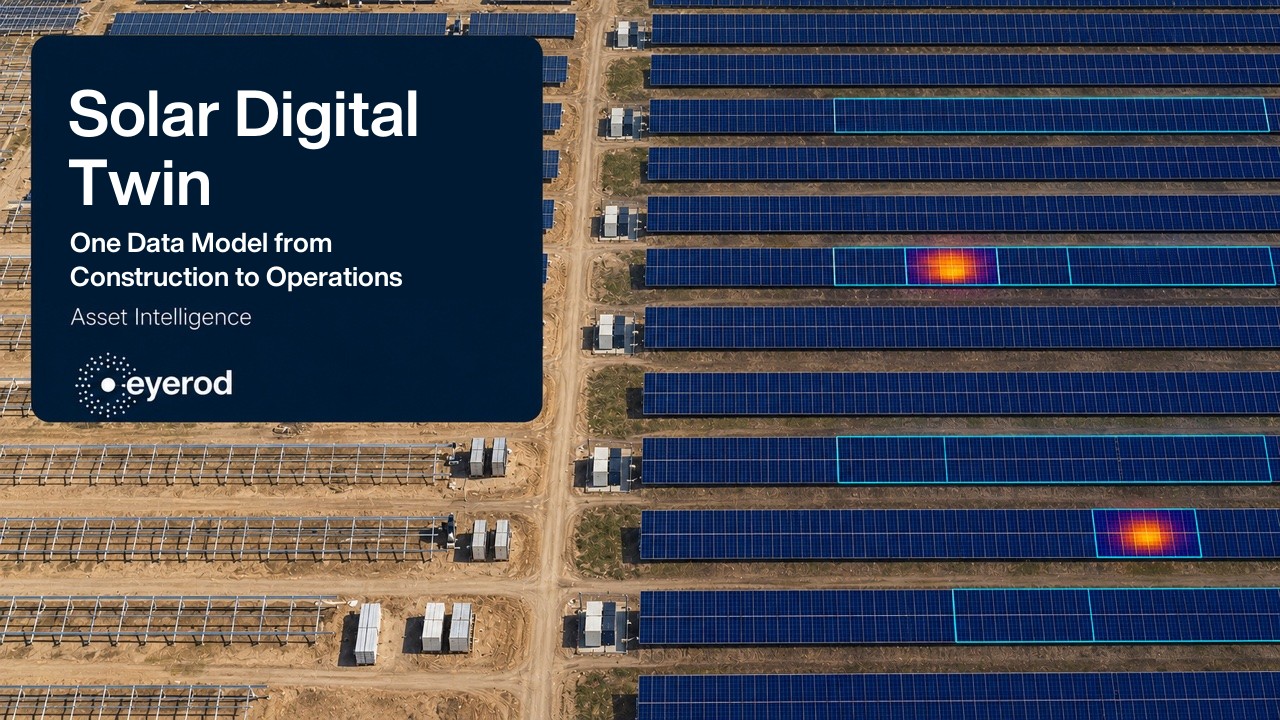
At a solar power plant, the information about a single module is created at different stages. Its position is set in the design, its installation is recorded on site, and its serial number goes into the acceptance file. During operations, thermal analysis findings, field checks and maintenance actions are added to that record. When this information is not tied to a shared asset identity, teams may have to piece together the history of the same equipment again at every review.
A solar digital twin makes it possible to assess the plant’s physical assets and the current data about those assets together, in a digital environment. The basis of an approach that runs from construction to operations is linking the information produced at each stage to the same asset and location record. What was planned on site, what was installed and which findings were recorded over time can then be tracked together.
What is a solar digital twin?
A solar digital twin is a digital representation of a solar power plant that is updated with real site data and used to support technical decisions. Depending on its scope, it can include equipment layout, relationships between assets, inspection history and operational data. IEA PVPS treats the digital twin in photovoltaic systems as a representation fed with real data throughout the lifecycle.
An orthophoto or a three-dimensional model shows how the plant looked on a given date. The digital twin approach adds asset identity, an update routine, historical records and decision support. What matters is which record a module seen on the map corresponds to, and how new findings are linked to that record.
A single data model here does not mean keeping every file in one database. Design, inspection, production and maintenance data can sit in different systems. What matters is that these systems identify the same physical asset consistently and that their records can be matched to one another.
How is a shared asset record set up?
The first step is defining the identity of the plant’s equipment and the relationships between items. The table a module sits on is a spatial relationship; the string and inverter it is connected to is an electrical relationship. The two should be kept together, and an electrical connection should not be assumed from the physical layout.
A useful asset record links the following information:
- A persistent asset or location ID and its position on the map
- The installed equipment’s serial number, manufacturer and model
- The related string, inverter and design revision
- Installation, inspection and commissioning records
- Dated inspection findings, maintenance actions and replacements
Keeping the location ID separate from the equipment serial number matters especially for replacements. When a module is replaced, the history recorded at that location is preserved, and the removed and installed modules are distinguished by their replacement dates. Findings that belong to the earlier equipment are then not attributed to the new module.
How is data created during construction prepared for operations?
The foundation of the digital twin can be laid by preparing the layout plan and asset definitions. As construction progresses, the planned state is compared with dated site records. Orthophotos and digital surface models produced from drone RGB imagery support the spatial layer of this comparison.
Piles, mounting structures and module installation should be recorded as separate progress stages. A module appearing in an image does not show that its electrical connection is complete or that it has passed commissioning tests. When the visual progress record and the test and acceptance documents are linked to the same asset, completion status can be assessed more clearly.
When site execution departs from the design, the related revision should also be added to the record. The as-built record, which shows what was actually installed, takes shape when these changes are processed consistently. The route of a backfilled cable trench, for example, may not be visible on the next flight; a located record captured during construction keeps its value for the operations team.
Continuity of information at handover
At the handover from the EPC team to the operations and maintenance team, delivering the files is not enough on its own. It also has to be clear which equipment each document belongs to, which revision is current and where open work is located. SolarPower Europe points out that unstructured handover data can require conversion or manual data entry in operations systems.
For this reason, the shared asset model should be prepared before handover. The current layout, equipment list, serial number matches, commissioning documents and open punch list items are linked to the relevant assets. Missing information is also kept visible. The operations team then knows which records it can rely on and which information it needs to verify on site.
The concrete output of this arrangement is a site history that can keep being updated after operations begin. Even if the team changes, the location, date and basis of an earlier check remain accessible. We covered how these records are used when a plant changes hands in digital asset and thermal records in solar plant acquisition.
How are thermal analysis findings used in the digital twin?
Thermal analysis and the digital twin are two separate processes that complement each other. First, thermal images collected under suitable conditions are analyzed. The findings of the completed analysis are then matched to the relevant module and location records on the digital twin. Here, the digital twin makes it possible to track where the analysis result sits on site and what history it has.
Consider an example workflow in which a thermal scan records a temperature pattern on a module that warrants attention. The finding is linked to the relevant asset together with its capture date, image and site conditions. The field team’s check and the action it took are added to the same record. When the same location is reassessed in the next scan, it can be compared with the earlier finding.
For this comparison to be meaningful, irradiance, wind, imaging conditions and the plant’s operating state have to be taken into account. A pattern not being recorded in the next scan does not by itself prove that the problem has been permanently resolved. Likewise, a thermal finding is not a direct root cause or a calculation of annual production loss.
What is the difference between a monitoring system and a digital twin?
A monitoring system shows the plant’s measured operating state. The digital twin approach makes it possible to assess together which asset these measurements belong to, where that asset is located and which site records it has been linked to in the past.
For example, a current drop in a string can be reviewed together with thermal findings on the modules connected to that same string. This requires the measurement tags in the monitoring system to be correctly matched to the asset records and the data to be comparable in time. The loss of a single module cannot be derived from a value measured at inverter level without additional evidence.
Similarly, GIS organizes spatial data, BIM organizes design and object information, and the maintenance management system organizes work orders. The scope of the digital twin is set by which decision these sources are linked for and how. Integrating every system is not required on every project.
From site data to asset history with eyerod
eyerod Construction Intelligence supports image-based site tracking during construction. Within Asset Intelligence, thermal analysis findings are linked to the relevant asset and coordinate records on the digital twin and can be tracked over time. What these two areas of use have in common is assessing site data together with its location and date.
When planning data continuity from construction to operations, which assets will be tracked, which records will be carried over and who will be responsible for updates should be decided at the outset. This sets up a scope that fits the project’s needs, and teams can assess a past finding in the same context as a new site record.
How construction and thermal inspection records can be assessed at a specific plant is outlined in eyerod solutions.
Frequently asked questions
Does a digital twin have to be real-time?
The update frequency should suit the intended use. Operational measurements can be refreshed at short intervals, while drone data can be updated in defined inspection periods. The Digital Twin Consortium definition also ties synchronization to a specified frequency and fidelity. The last update date of each data layer should be kept visible.
Does a drone flight on its own create a digital twin?
A drone flight provides imagery and spatial data. Matching this output to asset identities, updating it with new site data and using it in decision-making are workflows that have to be set up separately.
Can a digital twin be started later for an operating solar plant?
Yes. A baseline model is built from the current layout and equipment records. Older information that cannot be verified is clearly flagged, and subsequent inspection and maintenance records are added on a regular basis.
Does every plant need the same scope?
The scope should be set by the problem to be solved. The first need may be organizing module locations and inspection history. A connection to the monitoring system or more advanced modeling is considered once the decision it will support is clear.
What Is an Electroluminescence (EL) Test? How EL Testing Is Done on Solar Panels