What Is a Progress Payment? How Solar EPC Progress Is Verified for Payment
Constructioneyerod · · 10 min read
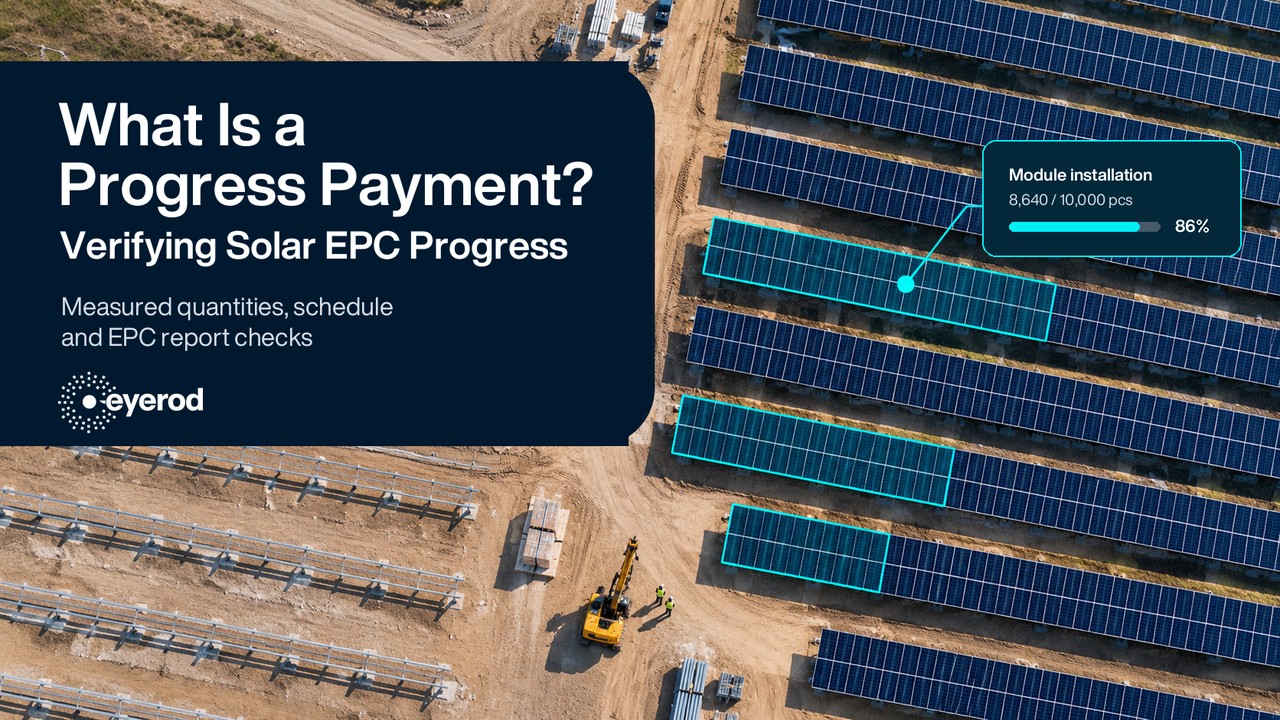
In construction and EPC contracts, a progress payment is the amount paid to the contractor for the work completed in a given period, after that work has been measured and assessed against the contract. On a solar power plant, progress payments depend on how far each work item has actually advanced on site, from pile (post) installation to mounting structure and module installation.
Reporting a work item as complete does not by itself mean that the payment conditions in the contract have been met. On large ground-mount solar projects in particular, the quantities claimed by the contractor need to be compared with the progress that can be verified on site.
This is where measured quantities, site surveys, construction progress reports and drone-based site tracking make the progress payment assessment more traceable and evidence-based.
What Is a Progress Payment in Construction?
A progress payment is a payment due to a contractor or subcontractor for work performed under the contract, calculated according to the contract's measurement and payment provisions. Depending on the market, the same process is called progress billing, a progress claim, a payment application or an interim payment.
A progress payment is not only the money value of completed work. It also has to document which work was completed, in what quantity, on which date and under which contract conditions.
Three elements are assessed when a progress payment is prepared:
- Work completed: The quantity and completion status of the contracted work on site.
- Contract value: The unit rate assigned to the work item, or the progress stage and payment milestone defined in the contract.
- Verification and acceptance: Whether the completed work is supported by measurement records and meets the technical specification and approval conditions.
On solar projects, this assessment depends on how the EPC (Engineering, Procurement and Construction) contract is structured.
Unit-rate contracts rely on verified quantities and unit rates. Lump-sum turnkey EPC contracts may use percent complete figures, a schedule of values or payment milestones instead.
For example, an EPC contract may define completion of the mounting structure and completion of module installation as two separate payment milestones. The amount tied to each milestone becomes payable only once the completion and acceptance conditions stated in the contract are met.
How Is a Progress Payment Calculated?
The calculation method follows the payment model in the contract.
Progress payments under unit-rate contracts
Under a unit-rate contract, the verified quantity of each work item is multiplied by its contract unit rate.
Work item value = Cumulative verified quantity × Contract unit rate
The amount for the current period takes into account the quantities or amounts already included in earlier progress payments.
Progress payment for the period = Cumulative value to date − Cumulative value of previous periods
Assume the following data for pile installation on a solar project:
| Progress payment calculation | Value |
|---|---|
| Total planned piles | 1,000 |
| Verified in the previous progress payment | 500 |
| Cumulative verified to date | 700 |
| Added this period | 200 |
| Contract unit rate | 750 per pile (contract currency) |
| Gross value of work this period | 150,000 (contract currency) |
In this example, the 200 additional piles are assumed to meet the relevant contract conditions. The calculation shows only the gross value of this work item; advance payment recovery, retention (retainage), taxes and other contractual adjustments are not included.
Progress payments under lump-sum EPC contracts
Under a lump-sum EPC contract, payment may not be based directly on counts or measured quantities. Percent complete, weighted work packages in a schedule of values or the milestones defined in the contract are used instead.
For example, the payment milestone for module installation may be tied to completing installation and the required checks in a specific block.
In that case, the number of installed modules is not enough on its own. Every condition defined for that payment milestone has to be shown as met.
How Do Measured Quantities Affect a Progress Payment?
A quantity takeoff estimates quantities from the design before or during construction. For a progress payment, what counts is the quantity of work actually built, measured in the units and under the measurement rules set out in the contract.
Different work items on a solar site are tracked in different units:
| Solar work item | Typical unit of measurement |
|---|---|
| Pile installation | Number (each) |
| Tracker or mounting structure installation | Number, set or the unit defined in the contract |
| PV module installation | Number (each) |
| Cable laying | Metre |
| Excavation and backfill | Cubic metre |
| Roads and site grading | Square metre, metre or cubic metre |
For a measured quantity to be reliable in a progress payment, the measurement method, the design revision and the definition of "complete" for each work item need to be clear.
For example, 5,000 modules being visible on site does not show that all of them have passed installation and electrical acceptance.
Likewise, the embedment depth or pull-out test result of a visible pile cannot be verified from aerial imagery alone.
This is why physical quantity measurement and technical acceptance are complementary but separate processes in a progress payment assessment.
Measured quantities are usually recorded in measurement sheets or a measurement book that supports each interim payment certificate. On private EPC projects, the format of these records follows the contract and the project's procedures.
What Does a Progress Payment Application Include?
A progress payment application (or progress billing) is the document that shows the quantities and values of the work completed up to a given date, assessed under the contract, together with the payment calculation. Once approved, it is typically issued as an interim payment certificate.
On a solar project, a progress payment application is expected to include the following, to the extent the contract requires:
- Project and period details: Project name, contract number, contractor, application number and reporting period.
- Work items: Piles, mounting structures, modules, cabling, civil works and other work packages.
- Quantity records: Total contract quantity, previous quantity, cumulative quantity to date and quantity completed this period.
- Pricing: Contract unit rates, percent complete figures or payment milestones.
- Payment summary: A summary combining the values calculated for each work item.
- Deductions and adjustments: Advance payment recovery, retention and other payment adjustments provided for in the contract.
- Supporting documents: Site measurement records, photographs, test reports, acceptance documents and required approvals.
A well-prepared progress payment application shows more than the total amount due. It also makes it possible to trace each quantity back to the work and measurement record it is based on.
On solar projects, linking these records to site coordinates and construction blocks makes it easier for investors and EPC teams to assess the reported progress.
How Is Progress Verified for a Solar EPC Progress Payment?
A central question in any solar progress payment assessment is whether the progress reported by the contractor matches what has actually been built on site.
This comparison relies on the current design, the measured quantities, the construction schedule and independent site records, assessed together.
1. Quantities in the EPC progress report are compared with site data
The first step is to review the work items reported in the EPC contractor's construction progress report.
For visible work such as pile driving, tracker installation and PV module installation, counts derived from drone imagery can be compared with the reported quantities, provided the image and data quality are adequate.
On large sites in particular, this shows how much work has been completed in each block.
2. Drone data supports quantity verification
Orthomosaics and digital surface models (DSM) produced from regular drone flights make it possible to review physical changes on site over time.
These datasets allow visible components to be detected and, under suitable measurement conditions, excavation and fill volumes to be compared.
Imagery alone does not prove that every item in a progress payment is acceptable, however. Backfilled cable trenches, underground works, connection torques and electrical tests require additional site records.
The value of drone data for a progress payment increases when it is assessed together with these technical documents.
3. Planned and actual progress are compared
The construction schedule shows the level each work item was planned to reach by each date.
Comparing actual quantities with the schedule identifies delays, deviations and work still awaiting completion.
However, schedule delay and progress eligible for payment are different indicators. A work item completed later than planned may still meet the payment conditions in the contract. The effect of a delay on payment or on liquidated damages is assessed separately under the contract.
The technical methods for verifying site progress are covered in detail in Solar Project Progress Tracking: How Is an EPC Progress Report Verified?.
How Does Construction Progress Tracking Software Support Progress Payments?
Construction progress tracking software is used to monitor the gap between planned work and completed work on a regular basis.
Progress can also be tracked in an Excel spreadsheet. On large ground-mount solar projects, however, merging files from different teams, keeping data current and matching each work item to its location on site can become a significant operational burden.
Map-based digital site tracking improves this process.
eyerod Construction Intelligence, for example, brings orthomosaics, component counts and excavation volume data derived from drone imagery together with site team records on a single platform.
Investors and EPC teams can then review where the reported work was carried out, how far it has advanced since the previous survey and where deviations exist.
These systems do not approve progress payments automatically under the contract. They provide a data foundation that helps assess the physical progress behind a progress payment against evidence.
The other components of drone-based site monitoring are covered in How to Track Solar Construction Progress with Drones.
Interim Payments vs. Final Account: What Is the Difference?
Interim payments are based on the work completed in each period while construction is under way. The final payment is made through the final account, prepared after the work has been completed under the relevant contract provisions, once final quantities and accounts have been assessed.
Interim payments focus on the quantities completed since the previous period. The final account assesses the outcome of the whole contract, account adjustments and the required closeout documents.
On solar projects, the following distinction matters most at completion and acceptance:
- Physical completion: The work has been carried out on site.
- Technical acceptance: The work has passed the required inspections, tests and specification checks.
- Contractual entitlement to payment: The conditions stated in the contract for the relevant payment milestone have been met.
These stages do not always fall on the same date.
Up-to-date as-built records, open non-conformities, test results and handover documentation play an important role in the final account and closeout.
A punch list tracks outstanding items and non-conformities, while an ITP (Inspection and Test Plan) defines which inspections and tests each type of work has to pass.
These processes are covered in Punch Lists and ITPs: Managing Solar Quality Before Closeout.
How progress and quality control are handled together across the construction stages is covered in Ground-Mount Solar Construction: Progress and Quality Control from Procurement to Commissioning.
Why Use Verifiable Site Data for Solar Progress Payments?
The core requirement in a progress payment assessment is to show which work on site, and which dated evidence, each reported quantity is based on.
Relying only on an overall percent complete figure or on the contractor's own data can leave missing work, quantity discrepancies and work awaiting acceptance insufficiently visible.
Regular site surveys, drone imagery and map-based progress records make it easier to compare the physical data used in a progress payment review.
eyerod Construction Intelligence makes actual progress on solar construction sites visible through drone data and site records, so that investors and EPC teams work from the same data.
More on how completed work is assessed with measurable site data and how reported progress is verified: eyerod Construction Intelligence.
Frequently asked questions
What is a progress payment in construction?
A progress payment is the amount due to a contractor for work completed in a given period, measured and assessed under the contract's measurement and payment provisions. It is also called progress billing, a progress claim or an interim payment.
How is a progress payment calculated?
Under a unit-rate contract, the cumulative verified quantity is multiplied by the contract unit rate and the cumulative value of previous periods is deducted. Lump-sum EPC contracts may use percent complete, weighted work packages in a schedule of values or payment milestones.
Can drone data verify a progress payment on its own?
No. Drone data helps assess the quantity and location of visible work. Backfilled cable trenches, underground works, connection torques and electrical tests require additional site records.
What is the difference between an interim payment and the final account?
Interim payments cover work completed in each period while construction is under way. The final account is prepared after the work is completed under the contract, assessing final quantities, account adjustments and closeout documents.
Ground-Mount Solar Construction: Progress and Quality Control from Procurement to Commissioning